
How to Choose the Right Gauge Aluminum Sheet Pan for Your Commercial Kitchen
Quick Answer: For most commercial kitchens, a 14-gauge to 16-gauge aluminium sheet pan is the best option. Pans made from 3003 or 3004 aluminium are strong, can handle high temperatures, and do not bend or warp easily. They are durable enough for everyday use and can last for many years. Keep reading to learn why these pans are a great choice and how to choose the right one for your kitchen.
If you operate a bakery, a restaurant or are part of the commercial food industry, you are no doubt aware that the aluminium sheet pan is one of the most-used items in your kitchen. But if you were to go out to purchase a new pan, you would come to a confusing crossroads: what gauge sheet pan should I buy? Most people just buy by the price and purchase pans that warp, cook unevenly and have to be replaced within a matter of months. Follow this guide, and you can make the right purchasing decision from the beginning, save money over time, and yield superior results every day.
What Does Gauge Actually Mean?
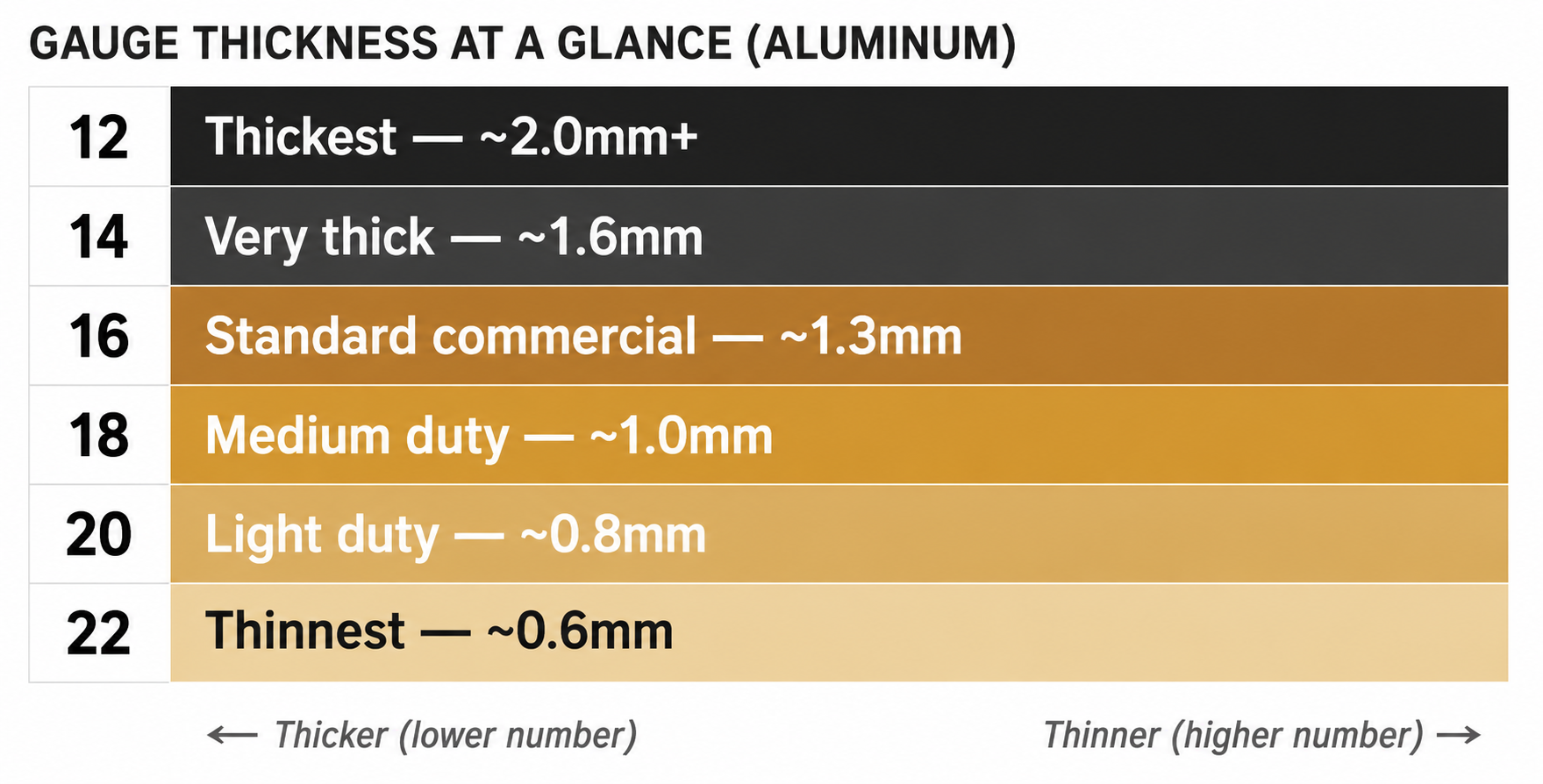
Gauge is a method used to determine how thick the metal is. The higher the gauge number, the thinner and weaker the metal. The opposite is also true, meaning a 12-gauge pan is thicker and heavier and a 22-gauge pan will be thin and light. While each has its benefits, for use in a commercial kitchen, a thicker pan is generally a superior option due to its longevity.
Why Does Gauge Matter So Much in a Commercial Kitchen?
In a home kitchen, a thin pan might be fine. You bake once or twice a week at moderate temperatures. But a commercial kitchen is a completely different world. Pans go in and out of ovens dozens of times a day, at high temperatures, carrying heavy loads.
Gauge affects three things that matter most in professional cooking:
Heat DistributionThicker pans spread heat more evenly across the surface. No hot spots means no burned corners and perfectly consistent results every batch. |
Warp ResistanceThin pans warp when they heat up and cool down repeatedly. A warped pan cannot sit flat in your oven — ruining bakes and creating a safety hazard. |
LifespanA quality 14-16-gauge pan used daily can last 5 to 10 years. A cheap thin pan may need replacing in under a year. |
The Complete Gauge Reference for Commercial Kitchens
| Gauge | Thickness | Best For | Rating |
| 12-gauge | 2.0mm+ | Industrial ovens, very high-volume production, heavy roasting | HEAVY DUTY |
| 14-gauge | 1.6mm | High-volume bakeries, daily roasting, heavy loads | TOP CHOICE |
| 16-gauge | 1.3mm | Restaurants, bakeries, everyday commercial baking | TOP CHOICE |
| 18-gauge | 1.0mm | Cafes, smaller commercial kitchens, moderate volume | GOOD |
| 19-gauge | 0.9mm | Moderate commercial use, light daily baking | GOOD |
| 20-gauge | 0.8mm | Low-volume production, not recommended for daily commercial use | LIGHT DUTY |
| 22-gauge | 0.6mm | Home use only — not suitable for commercial kitchens | HOME USE |
Which Aluminum Alloy Should You Look For?
This indicates the thickness of the pan. The alloy indicates what the pan is made from; however, this is also just as important.
There are two common alloys used in commercial sheet pans: 3003 aluminium and 3004 aluminium. Either one would be a perfect fit for your commercial kitchen. These are ideal because:
- They conduct heat evenly and quickly to ensure consistent food cooking every time.
- They are lead-free and safe to contact food-which is an absolute necessity in a certified commercial kitchen.
- They resist corrosion so the pans are longer-lasting when exposed to heavy use, frequent washing and high heat.
- They are strong and durable and won’t dent or bend when handling heavy amounts of food.
If a pan says just aluminium without mentioning the specific alloy, you must inquire. A good supplier should readily give you the alloy grade.
Watch out: Many cheap pans sold online are made from low-grade aluminium without any alloy specification. These pans warp faster, heat unevenly, and may not meet food safety standards for commercial use. Always verify the alloy grade before purchasing in bulk.
Open Bead vs. Closed Bead Rim — What Is the Difference?
The rim of a sheet pan is just as important as the gauge. Most commercial pans come with either an open bead or closed bead rim — and the difference is practical.
Open bead rim
The wire reinforcement at the edge is exposed. These pans are strong and resist warping well. However, over time, moisture and food particles can get inside the open rim and lead to rust or bacteria buildup if not cleaned carefully.
Closed bead rim
The wire reinforcement is fully enclosed by the aluminium. This prevents moisture from getting in, making the pan much easier to keep hygienic and significantly extending its lifespan. For most commercial kitchens where hygiene standards are strict, a closed bead rim is the smarter long-term investment.
What Pan Size Do You Actually Need?
Gauge and alloy aside, the size of your sheet pan must match your oven and your output. The standard sizes used in commercial kitchens are:
- Full size (18″ x 26″): Fits standard commercial convection ovens. Best for high-volume bakeries and large-scale food production.
- Half size (18″ x 13″): Versatile. Good for smaller batches, prep work, or kitchens with smaller ovens.
- Two-thirds size (16″ x 22″): A middle option that offers more space than a half-size but still fits in most commercial ovens.
- Quarter size (13″ x 9″): Used for small portions, garnishes, or prep stations.
Before buying in bulk, measure your oven racks. A pan that is even half an inch too wide will not slide in properly, and you will have wasted your investment.
Perforated vs. Solid Bottom — Which Is Right for You?
Some sheet pans have small holes punched into the bottom. These are called perforated pans. Others have a solid, flat bottom. The right choice depends on what you are cooking.
- Use perforated pans when you want maximum airflow and crispiness — ideal for buns, rolls, bread, and anything that should have a crisp bottom crust.
- Use solid bottom pans for roasting, baking cookies, cakes, cakes, sheet cakes, and any wet or oily food where you do not want dripping.
How Many Pans Do You Need? Planning for Your Volume?
This is a question many kitchen buyers overlook. Having the right gauge means nothing if you run out of pans mid-service. A general rule used in professional kitchens:
- Small cafe or pastry shop: 12 to 20 full-size pans to start.
- Mid-size restaurant or bakery: 30 to 50 pans, with spares for rotation.
- High-volume production kitchen: 60 to 100+ pans, planned across shifts.
Having enough pans also means you can let them cool properly between uses, which reduces warping and extends their lifespan significantly.
Frequently Asked Questions (FAQs)
What gauge aluminium sheet pan is best for a commercial kitchen?
For most commercial kitchens, a 14-gauge to 16-gauge aluminium sheet pan is the best choice. It is thick enough to resist warping, distributes heat evenly, and lasts through high-volume daily use.
Is a lower gauge sheet pan thicker or thinner?
Lower gauge means thicker metal. A 12-gauge pan is thicker and heavier than a 20-gauge pan. For commercial use, always prefer a lower gauge number for durability and even baking.
What is 3003 aluminium in sheet pans?
3003 aluminium is a commercial-grade alloy widely used in sheet pans. It offers excellent heat conductivity, corrosion resistance, and durability — making it the industry standard for commercial baking equipment. 3004 aluminium is a slightly stronger variant also commonly used.
What size sheet pan fits a standard commercial oven?
A full-size sheet pan measuring 18 x 26 inches fits most standard commercial convection ovens. Half-size pans (18 x 13 inches) are also widely used for smaller batches or kitchens with tighter oven rack space.
Can I use a home-grade sheet pan in a commercial kitchen?
It is not recommended. Home-grade pans are typically 20-gauge or thinner and are not built to handle the daily heat cycles of a commercial kitchen. They warp quickly, heat unevenly, and will need frequent replacement — costing you more in the long run.