
Aluminium Kitchenware Manufacturer in India
Vikas Kitchenware is the most prominent aluminium kitchenware manufacturer in India and manufactures kitchenware for household use as well as for hotel, restaurant, catering, and institutional kitchen applications. We have combined many years of expertise in metallurgy with modern pressing and spinning techniques to produce commercial-quality kitchenware suitable for heavy-duty use in commercial kitchens as well as for regular domestic purposes.
Every single product we manufacture is designed to distribute heat evenly, provide a long lifespan and uniform wall thickness – which are the criteria distinguishing the manufacturer from the mere rebrander of third-party products.
As a kitchen equipment exporter and restaurant equipment distributor, we work with OEMs, wholesalers and hospitality chains in the Middle East, Africa and Southeast Asia.
Commercial-Grade Aluminium Cookware Specifications (3003 Alloy)
The materials used to make our commercial and heavy-duty cooking equipment mainly consist of 3003-H14 aluminium alloy. The type of material is a standard one used in the industry because of its high level of formability, corrosion resistance, and ability to withstand thermal stress cycles.
In addition to that, we provide anodised aluminium cookware and mill-finish aluminium cookware, and this is a significant factor for business-to-business clients.
Alloy & Material Specifications
| Parameter | Specification |
|---|---|
| Alloy Grade | 3003-H14 (Aluminium-Manganese Alloy) |
| Chemical Composition | Al ≥ 96.7%, Mn 1.0–1.5%, Fe ≤ 0.7%, Si ≤ 0.6%, Cu 0.05–0.2%, Zn ≤ 0.1% |
| Tensile Strength | 145–186 MPa (typical for H14 temper) |
| Yield Strength | ≥ 125 MPa |
| Elongation at Break | 8–16% |
| Gauge Thickness Range | 16 gauge to 18 gauge (approx. 1.2 mm – 1.6 mm) |
| Heavy-Duty Range | 12 gauge to 14 gauge (approx. 2.0 mm – 2.6 mm) for commercial-volume cookware |
| Thermal Tolerance | Stable performance up to 400°C; safe continuous use range 200°C – 260°C |
| Finish Options | Standard mill finish, anodized (Type II), polished, sandblasted |
| Base Thickness (induction-compatible SKUs) | 3–4 mm forged base |
Anodised vs Standard Aluminium — Which Should You Specify?
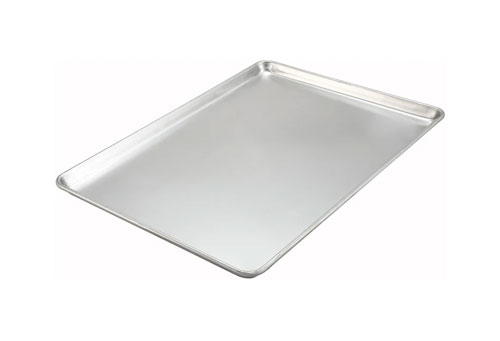
| Attribute | Standard Aluminium | Anodized Aluminium |
|---|---|---|
| Surface Hardness | Moderate | High (electrochemically hardened oxide layer) |
| Corrosion & Staining Resistance | Good | Excellent |
| Non-Reactivity with Acidic Foods | Adequate | Superior |
| Recommended Use Case | High-volume budget cookware, bulk institutional supply | Premium retail lines, export markets with stricter compliance expectations |
| Relative Cost | Lower | Higher |
Customers buying cookware for hotels, cloud kitchens, and export retail will require cookware with an anodised finish, but in terms of cookware for commercial purposes, plain aluminium is considered to be more suitable.
Manufacturing Capabilities of Trusted Aluminium Kitchenware Manufacturer in India
Our production facility is built around deep-draw pressing, spinning, and CNC trimming lines designed for both high-mix/low-volume custom orders and continuous bulk manufacturing.
Key manufacturing capabilities include:
- Press Capability: Hydraulic and Mechanical Presses of 300–500 tonnes, capable of deep-drawing to form kadhais, tope sets, and handis in various diameters.
- Circle Cutting & Blanking: In-house lines capable of performing the slitting and circle cutting of aluminium coils/sheets in order to produce production blanks with minimised wastage.
- Spinning Lines: Manual and CNC spinning lines capable of producing tapered and specialised cookware that cannot be made by press alone.
- Polishing & Finishing: Automated buffing, anodising, and sandblasting lines for uniformity of finish.
- Quality Control: Dimensional checks (gauge and weighing), leak/pressure testing per batch prior to packaging.
- ISO-Certified Manufacturing Processes: The manufacturing process is ISO 9001-based Quality Management Systems, which guarantees dimensional control for every production batch—a prerequisite for institutional buyers and export markets when onboarding the vendor.
With the above facilities and capabilities, we are able to cater to both large tenders from hotel chains and smaller trials from new distributors without any compromise on tolerance and turnaround time.
Supply Chain and Export Logistics for B2B Buyers
We deal directly with restaurant supply distributors, wholesalers, importers, and kitchen equipment exporters and have a supply chain that works based on the following B2B fulfilment:
- MOQ & Custom Branding: MOQs adjusted to the needs of both first-time distributors and established buyers; private label or OEM brand available on packaging and product embossing.
- Packaging for Export: Corrugated and palletised packaging able to withstand shipping via sea freight.
- Documentation: Commercial invoices, packing list, certificate of origin, and HS code classification included.
- Lead Times: Standard lead times quoted along with the ability to expedite production orders for repeat B2B customers.
- Export Markets: Middle East, Africa, Southeast Asia, and other markets interested in inexpensive yet sturdy commercial cookware.
- Quality Reports: Batch test reports can be provided on request by institutional or government buyers.
Whether you’re a restaurant supply distributor filling a regional hospitality market, or a kitchen equipment exporter expanding your own private label product line – we will be happy to structure the terms of your supply deal based on your needs.
Frequently Asked Questions (FAQ)
1. What alloy is used in your commercial aluminium cookware?
Our commercial-grade cookware is manufactured primarily from 3003-H14 aluminium alloy, chosen for its strength, corrosion resistance, and consistent performance under repeated heating cycles in commercial kitchens.
2. What is the difference between anodised and standard aluminium cookware?
Anodised aluminium undergoes an electrochemical process that hardens the surface and improves resistance to corrosion and acidic foods, making it suitable for premium and export-facing product lines. Standard (mill-finish) aluminium is more cost-effective and widely used for high-volume, back-of-house commercial cookware.
3. Do you manufacture heavy-duty cookware for restaurants and catering businesses?
Yes. We produce heavy-duty cookware in thicker gauge ranges (12–14 gauge) specifically engineered for high-frequency commercial use, in addition to our standard 16–18 gauge range for regular household and light commercial applications.
4. Is Vikas Kitchenware is ISO-certified?
Our manufacturing processes are ISO 9001-aligned, covering quality control, batch traceability, and dimensional consistency across production runs — documentation we provide to institutional and export buyers during vendor evaluation.
5. Can you fulfil export orders and provide shipping documentation?
Yes. We regularly work with kitchen equipment exporters and international distributors, providing export-grade packaging, commercial invoices, certificates of origin, and HS code support for customs clearance.
6. What is minimum order quantity (MOQ) for B2B buyers to purchase aluminium kitchenware?
MOQs vary by product and finish. We accommodate both trial orders from new restaurant supply distributors and large-volume tenders from hotel chains and institutional buyers — contact our sales team for a product-specific quotation.